Mock tests are one of the best ways to understand your preparation level before the CA exams. But what happens when you attempt a mock test and the score is much lower than expected?
You may start thinking:
- “I studied this chapter, so why couldn't I solve the questions?”
- “What if I score the same marks in the actual exam?”
- “Should I change my entire study plan?”
- “Is my preparation really enough for the September 2026 attempt?”
If you are preparing for the CA Foundation or CA Intermediate September 2026 exams, don't let one or two low mock-test scores decide your confidence.
A mock test is not your final result. It is a diagnostic tool that shows you where your preparation needs improvement.
The important question is not “How many marks did I get?”
It is “Why did I lose those marks?”
Let's understand how you can use your mock-test performance to improve before the CA September 2026 exams.
Why Are You Scoring Low in CA Mock Tests?
Before trying to increase your score, identify the actual reason behind it.
A low score can happen because of several reasons:
- You haven't revised the syllabus properly.
- You know the concept but cannot apply it.
- You are making calculation mistakes.
- You are forgetting important provisions or formulas.
- You are not managing your exam time properly.
- You are misunderstanding the question.
- You are leaving questions incomplete.
- You are not presenting answers properly.
- You are attempting too many questions without sufficient revision.
- You are feeling nervous under exam-like conditions.
The solution depends on the reason.
Read More: Big 4 vs Mid-Size CA Firms: Which Is Better for Freshers?
Don't Treat Every Mock-Test Mistake the Same Way
One of the biggest mistakes students make is simply checking their marks and moving on.
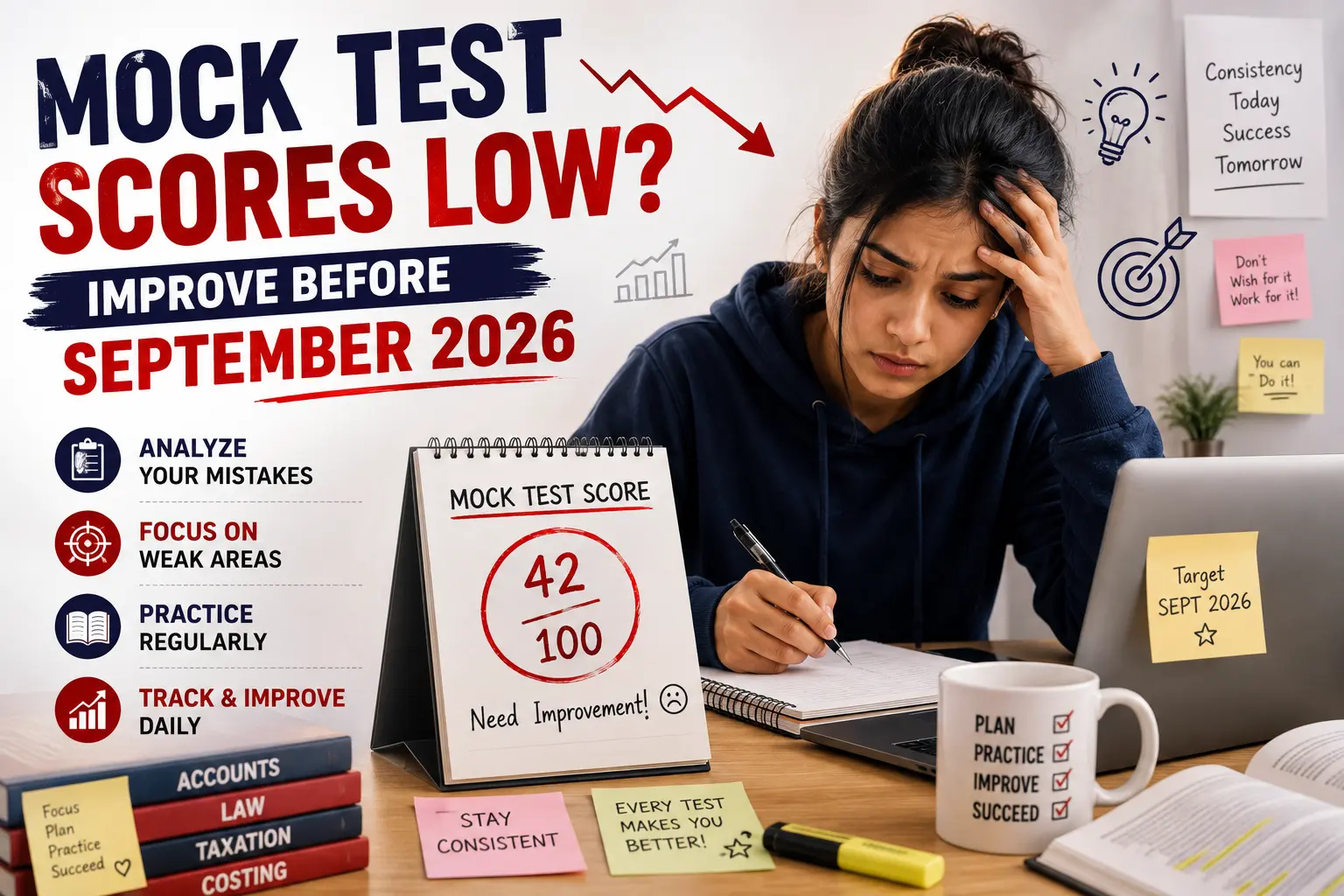
Suppose you scored 42/100.
That number alone doesn't tell you much.
Instead, divide your mistakes into different categories.
1. Conceptual Mistakes
You didn't understand the concept properly.
Action: Go back to your study material or class notes and revise the concept.
2. Revision Mistakes
You studied the topic earlier but forgot it during the test.
Action: Add it to your revision list and revise it again after a few days.
3. Practice Mistakes
You understood the concept but couldn't solve the practical question.
Action: Solve more questions from the same concept.
4. Silly Mistakes
You knew the answer but made a calculation, reading, or copying error.
Action: Slow down during important steps and check your work.
5. Time-Management Mistakes
You knew the answers but couldn't complete the paper.
Action: Practice full-length papers with a fixed time limit.
6. Presentation Mistakes
Your answer contained the right information but wasn't presented effectively.
Action: Work on proper working notes, headings, formats, calculations, and point-wise presentation wherever appropriate.
Step 1: Analyse Your Mock Test Before Taking Another One
Don't immediately start another mock test after scoring low.
First, analyse the previous paper.
Create four categories:
| Category | What It Means | What You Should Do |
|---|---|---|
| Didn't Know | Concept not prepared | Study the topic |
| Forgot | Previously studied but couldn't recall | Revise again |
| Couldn't Solve | Concept understood but application weak | Practice questions |
| Silly Mistake | Knew the answer but made an error | Improve checking |
This simple analysis can tell you much more than your total score.
Step 2: Find Your Weak Chapters
Your overall score may look disappointing, but your actual problem may be limited to a few chapters.
For example, if you are preparing for CA Intermediate and repeatedly losing marks in particular areas of Advanced Accounting, Cost and Management Accounting, Taxation, or Financial Management, don't randomly revise the entire syllabus.
Identify the chapters where you are consistently making mistakes.
Make a list such as:
- Chapter A – Conceptual weakness
- Chapter B – Calculation mistakes
- Chapter C – Poor question practice
- Chapter D – Revision required
Now your preparation becomes targeted.
Step 3: Follow the “Mock → Analysis → Revision → Practice” Cycle
Don't treat mock tests as one-time exams.
Use this cycle:
Mock Test → Analyse Mistakes → Revise Weak Topics → Practice Questions → Take Another Mock
This is much more effective than continuously taking mock tests without analysing them.
If you take five mock tests but repeat the same mistakes in all five, the number of tests won't automatically improve your preparation.
Step 4: Revise Before Attempting Another Mock
After analysing your paper, spend time fixing your weak areas.
For example:
If you made conceptual mistakes:
- Read the relevant ICAI Study Material.
- Review your class notes.
- Re-watch a difficult concept if necessary.
- Solve basic questions first.
If you made practical mistakes:
- Solve similar questions.
- Practice without looking at the solution.
- Identify exactly where your approach went wrong.
If you forgot formulas or provisions:
- Create short revision notes.
- Use flashcards.
- Revise them repeatedly instead of reading them only once.
Step 5: Improve Your Time Management
Sometimes students know enough to score well but lose marks because they cannot complete the paper.
During your next mock test, don't just track your marks.
Track your time.
Ask yourself:
- How much time did I spend on the first question?
- Which questions consumed too much time?
- Did I spend too long on one difficult problem?
- Did I leave easy questions for later?
- Did I have enough time to review my answers?
The goal is to develop a realistic CA exam time-management strategy before September 2026.
Step 6: Practice Questions Without Looking at the Solution
A common problem during preparation is thinking:
“I understand the solution.”
But understanding someone else's solution is different from solving the question yourself.
After revising a topic, close your notes and attempt questions independently.
If you get stuck, identify the exact step where you struggled.
This will improve your problem-solving ability much more effectively than simply reading solutions.
Step 7: Use ICAI Material as Your Core Resource
While using mock tests and other practice resources, don't forget the importance of ICAI Study Material.
Your preparation should be built around official ICAI resources and the applicable syllabus for your attempt.
Use additional resources for practice and revision, but don't completely replace your core study material with random notes or online content.
For the September 2026 attempt, students should also make sure they are studying the applicable amendments, RTPs, MTPs and other relevant ICAI material for their examination.
Step 8: Improve Subject-Wise Instead of Chasing an Overall Score
Every subject may not improve at the same speed.
Suppose your mock-test performance looks like this:
- Subject 1: 65
- Subject 2: 48
- Subject 3: 37
- Subject 4: 54
Instead of thinking, “My overall preparation is bad,” identify Subject 3 as your immediate priority.
Work on the weakest areas while maintaining the subjects where you're already performing reasonably well.
CA Foundation Students: How to Improve Mock-Test Scores
If you are preparing for CA Foundation September 2026, your preparation should include regular practice across all four papers.
Focus on:
Accounting
- Practice practical questions regularly.
- Review calculation errors.
- Revise formats and adjustments.
- Don't just read solved examples.
Business Laws
- Focus on understanding provisions.
- Practice writing answers in a structured manner.
- Revise important legal concepts regularly.
Quantitative Aptitude
- Practice questions under time limits.
- Revise formulas.
- Identify calculation errors.
- Focus on speed as well as accuracy.
Business Economics
- Revise concepts repeatedly.
- Practice objective questions.
- Analyse incorrect answers instead of simply checking the correct option.
CA Intermediate Students: How to Improve Mock-Test Scores
For CA Intermediate September 2026, mock-test analysis becomes particularly important because of the depth and application required across subjects.
Focus on:
Advanced Accounting
Identify whether your problem is:
- Accounting treatment
- Application of Accounting Standards
- Adjustments
- Calculation
- Presentation
Then practice questions specifically targeting that weakness.
Corporate and Other Laws
If you are losing marks because you forget provisions, focus on repeated revision and answer-writing practice.
Taxation
Check whether your mistakes are related to:
- Conceptual understanding
- Computation
- Provision recall
- Amendments
- GST concepts
Cost and Management Accounting
Don't only revise formulas.
Practice their application through numerical questions.
Auditing and Ethics
Focus on concepts, terminology, standards, and answer presentation.
Financial Management and Strategic Management
For FM, identify calculation and formula-related mistakes.
For SM, focus on understanding concepts and presenting answers appropriately.
Read More: CA Foundation September 2026: 30-Day Exam Preparation Plan
How Many Mock Tests Should You Attempt Before September 2026?
There is no magic number of mock tests that guarantees a particular score.
Quality matters more than quantity.
Instead of asking:
“How many mock tests should I solve?”
ask:
“How many mock tests can I properly analyse and learn from?”
One properly analysed mock can be more useful than several tests that you attempt without reviewing your mistakes.
A good approach is to gradually increase full-length exam practice as you get closer to the examination.
Keep a “Mistake Notebook”
This can become one of your most useful revision tools.
After every mock test, record:
- Questions you got wrong
- Concepts you forgot
- Formulas you missed
- Calculation errors
- Time-management problems
- Presentation mistakes
- Questions you couldn't attempt
Then revise this notebook regularly.
Instead of revising the entire syllabus every time, you will have a personalised list of the areas that actually need attention.
Don't Take a Low Mock Score Personally
This is especially important during the final phase of preparation.
A low mock score can make you feel that you are not prepared enough.
But remember:
A mock test is feedback, not a final judgement.
If you score 40 today and identify why you lost those 60 marks, you have valuable information that can help you improve.
The real problem isn't getting a low score in one mock.
The real problem is getting a low score and doing nothing about it.
What to Do After a Bad Mock Test?
Follow this simple process:
- Check your paper calmly.
- Calculate how many marks were lost because of concepts.
- Identify questions lost due to lack of revision.
- Mark calculation and silly mistakes.
- Identify time-management issues.
- Revise weak topics.
- Practice similar questions.
- Attempt another mock after sufficient improvement.
- Compare your performance.
- Repeat the process.
30-Day Mock Test Improvement Strategy for CA September 2026
If the exam is approaching and your mock scores are still low, don't panic and completely change your preparation strategy.
Phase 1: Analyse
Identify your weakest subjects and chapters.
Phase 2: Repair
Revise concepts and solve questions from those areas.
Phase 3: Practice
Attempt topic-wise and full-length questions.
Phase 4: Test
Take another mock under exam conditions.
Phase 5: Analyse Again
Compare your mistakes with the previous test.
The goal isn't simply to take more tests.
The goal is to make fewer mistakes in every subsequent test.
Common Mistakes Students Make With Mock Tests
Avoid these mistakes before the September 2026 exams:
- Taking mock tests without completing revision.
- Checking only the final score.
- Ignoring incorrect answers.
- Looking at solutions too quickly.
- Repeating the same mistakes.
- Focusing only on difficult questions.
- Ignoring time management.
- Not practising full-length papers.
- Completely changing the study plan after one bad score.
- Comparing mock scores with friends.
Important Points to Note
Scoring low in a CA mock test can be disappointing, but it can also be extremely useful.
Your mock test is showing you exactly where you need to improve before the September 2026 CA exams.
Don't ask only:
“How many marks did I score?”
Ask:
“Why did I lose these marks, and what am I going to do differently next time?”
Analyse your mistakes, revise your weak areas, practise consistently, and use every mock test as a learning opportunity.
Remember, the purpose of a mock test is not to prove that you are already perfect.
It is to help you become better before the real exam.
Frequently Asked Questions
Is it normal to score low in CA mock tests?
Yes. Mock-test scores can vary depending on your preparation, revision, difficulty level, and exam conditions. What matters is whether you analyse your mistakes and improve.
How can I increase my CA mock test score?
Start by identifying why you are losing marks. Then revise weak concepts, practise similar questions, improve time management, and attempt another mock after addressing your mistakes.
Should I take another mock test immediately after scoring low?
Not necessarily. First analyse the paper and fix your weak areas. Taking another test without addressing your mistakes may result in repeating the same errors.
Are mock tests important for CA September 2026 preparation?
Yes. Mock tests can help you assess preparation, practise time management, improve answer presentation, and identify weak areas before the actual examination.