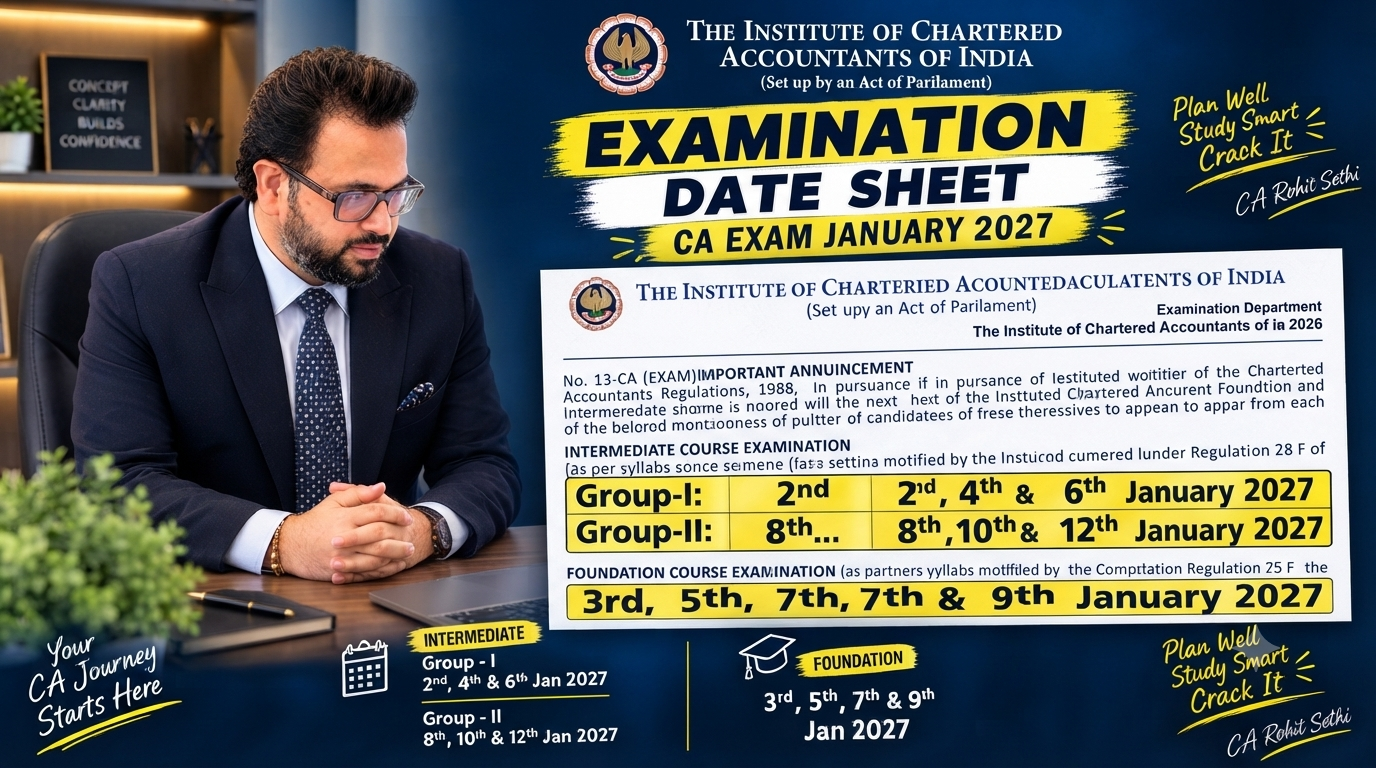
Are you preparing for CA Foundation January 2027? Is your course still going on and expected to be completed by the end of November?
Then there is one thing you should start doing right now: start your revision before your CA Foundation course is complete.
Yes, you read that correctly. You do not need to wait until December to start your CA Foundation revision. In fact, if your CA Foundation classes are currently going on, this is the perfect time to develop a habit of revising the syllabus that has already been completed.
And don’t worry—I am not asking you to study for another 5–6 hours every day. I am talking about 1.5–3 focused hours of additional revision, depending on your daily schedule. Because there is one simple thought that I want every CA Foundation January 2027 student to remember:
“The difference between ordinary and extraordinary is that extra.”
Why Should You Start CA Foundation Revision While Your Course Is Still Going On?
Let’s understand the reality of a CA Foundation student’s day. Suppose you have 5 hours of classes, 1 hour of travelling, and 2–3 hours of homework and question practice. That is already 8–9 hours of your day. So naturally, you may think: “Sir, 9 hours toh already ho gaye. Ab revision ke liye aur time kahan se niklega?”
That’s a fair question. And that’s exactly why your revision strategy should be smart, not extreme. You don’t need another 5 hours. Try to find an additional 1.5–3 focused hours for revision.
These hours are not for attending today’s classes. They are not for completing today’s homework. They are specifically for revising the CA Foundation syllabus that you have already completed. This small additional effort, when repeated consistently, can make a huge difference by the time your course finishes.
The Biggest CA Foundation Preparation Mistake: Waiting for the Course to Finish
One of the most common mistakes students make is: “Pehle poora course complete kar lete hain, phir revision start karenge.” It sounds logical. But let’s see what actually happens.
Suppose you complete a chapter in September. You understand it. You make your notes. You complete your homework. Then you move to the next chapter. Then another. Then another. By the end of November, you may have completed a large portion of the CA Foundation syllabus. But how much of the September syllabus do you still remember?
This is where the problem begins. When you finally start your CA Foundation revision in December, you may find yourself saying: “Ye chapter padha toh tha… but ab properly yaad nahi aa raha.” That doesn’t necessarily mean you didn’t study properly. It means the chapter hasn’t been revised.
Learning and remembering are two different things. That’s why your CA Foundation preparation should not follow: Learn → Forget → Revise. Instead, it should follow: Learn → Revise → Practise → Revise Again.
CA Foundation January 2027 Preparation Strategy: Use Two Tracks
Your preparation should run on two parallel tracks.
Track 1: Current Course
Focus on whatever is currently being taught. Your priorities should be: attend your CA Foundation classes, understand the concepts, complete homework, practise questions, clear doubts, and stay on track with the ongoing syllabus.
Track 2: Completed Course
At the same time, keep revising the chapters that have already been completed. Your revision should include: concept revision, formula revision, important provisions, question practice, MCQs, previously incorrect questions, and self-testing.
In simple words: current course ko chhodna nahi hai, aur completed course ko bhoolna bhi nahi hai. That is the real idea behind revision along with the course.
How Many Hours Should You Study for CA Foundation January 2027?
There is no universal CA Foundation timetable that will work perfectly for every student. Your timetable depends on number of classes, travel time, homework, college/school schedule, your learning speed, and your existing preparation level. So don’t blindly copy someone else’s 12-hour study timetable. Instead, build a realistic CA Foundation study plan around your actual day.
If you already spend around 8–9 hours on classes, travel and homework, then a practical target could be 1.5–3 hours of revision on most days. For example:
60 Minutes — Practical Subject
For Accounting or Quantitative Aptitude: revise concepts, revise formulas, solve selected questions, reattempt previously incorrect questions.
60 Minutes — Theory/Conceptual Subject
For Business Laws or Business Economics: revise a completed chapter, use active recall, revise important concepts, practise MCQs where applicable.
30–60 Minutes — Weak Areas
Use this time for difficult chapters, backlog, mistakes, and topics you keep forgetting.
You don’t need to follow this exact structure every day. The important thing is to ensure that completed portions remain active in your memory.
CA Foundation Revision Strategy: Don’t Just Read Your Notes
This is extremely important. Many students say “I revised the chapter.” But what they actually did was read the chapter again. Reading is useful. But active revision is much more powerful.
Suppose you completed a Business Laws chapter two weeks ago. Close your book. Now ask yourself: What were the major provisions? What were the important concepts? Can I explain them without looking? What examples did I study? What are the keywords? What questions can be asked from this topic? Then open your notes and check. This is called active recall.
The same principle works for practical subjects. Instead of looking at the solution and thinking “Haan, ye toh mujhe aata tha,” try the question yourself first. Question → Attempt → Check → Analyse. That is much better exam preparation.
Put Active Recall to the Test — Properly
Reading your notes again isn’t a real test of what you remember. Our Test Series lets you attempt a real chapter-wise paper, upload your solved answer sheet, and get it checked by our faculty with actual marks & remarks — so you know exactly what you’ve retained and what still needs work.
What If Your Homework Takes 2–3 Hours?
This is where many students get stuck. You may genuinely have a very heavy day: five hours of class, one hour of travel, three hours of homework. And then you’re expected to revise for three hours? That may not be realistic every day.
So don’t make your CA Foundation study plan so aggressive that you cannot sustain it. On a heavy day, 45–60 minutes of revision is still valuable. On a lighter day, 2–3 hours can be your target. The objective is not perfection. The objective is consistency.
Because the real danger isn’t studying less on one day. The real danger is: “Aaj nahi hua.” Then “Kal kar lenge.” Then “Weekend pe kar lenge.” And suddenly 15 days have passed. So make one simple rule: No Zero Revision Day. Even if you have only 45 minutes, revise something.
CA Foundation Study Plan: The 70:30 Rule
A useful starting point is to divide your study time approximately like this: 70% — Current Course, 30% — Completed Course Revision.
This is not a rigid formula. Some days your current classes may require more time. Some days your revision may need more attention. That’s okay. The principle is: don’t allow your entire study day to become only current-course preparation. Because if you do that for three months, you may finish the syllabus but simultaneously forget the chapters you completed earlier.
Weekly Revision Is Also Important
Daily revision is important. But you should also have a weekly CA Foundation revision plan. Keep one longer revision slot every week. For example, on Sunday — Weekly Revision + Test: review the chapters covered in your previous study cycle, then test yourself.
For example: Accounting — solve selected practical questions. Business Laws — revise provisions and practise questions. Quantitative Aptitude — solve questions without looking at the method. Business Economics — revise concepts and practise MCQs.
The purpose of the test isn’t just to get a high score. The real question is: “Mujhe actually kitna yaad hai?” Your mistakes will tell you exactly where your preparation needs more work.
Don’t Wait for December to Start Your First Revision
If your CA Foundation course is expected to be completed by the end of November, December should not be the month when you discover the syllabus for the second time. Instead, December should be used for full syllabus revision, question practice, mock tests, weak chapter revision, mistake analysis, formula revision, and important concept revision.
Your preparation should ideally reach this stage:
November End — Syllabus Completed + Earlier Portions Revised
↓
December — Full Revision + Practice + Tests
↓
January — Final Revision + Mock Tests + Exam Readiness
This is much better than: November End — Syllabus Completed ↓ December — “Now let’s start revision from Chapter 1.”
CA Foundation January 2027: What Should You Achieve by November End?
Your target should not simply be “I have completed the syllabus.” Your target should be: “I have completed the syllabus and I have been revising the earlier portions regularly.” That’s a huge difference.
Imagine two students.
Student A — September–November: Classes + Homework. December: First Revision.
Student B — September–November: Classes + Homework + Regular Revision. December: Revision + Practice + Tests.
Both students may have attended the same classes. Both may have completed the same syllabus. But their preparation entering December is very different. Student B doesn’t have to relearn everything. The concepts are already familiar. Now the focus can shift towards: Revision → Practice → Testing → Analysis → Improvement.
What If You Already Have a Backlog?
Don’t panic. But don’t make another mistake: don’t stop your current course completely to finish your backlog. If you do that, today’s current syllabus can become tomorrow’s backlog.
Instead, divide your time between Current Course + Backlog + Revision. For example: current class/homework — priority; 60–90 minutes — backlog; 45–90 minutes — revision. And use your weekly off-day for additional backlog clearance.
Also, don’t write “Complete Accounts backlog.” That’s too vague. Instead write “Complete Chapter X lecture + solve 15 questions today.” Specific targets are easier to execute.
The Best CA Foundation Revision Technique: Close the Book
Here’s a simple exercise. Pick a chapter you completed two or three weeks ago. Don’t open your book. Take a blank sheet of paper. Write down everything you remember: concepts, formulas, provisions, formats, adjustments, important questions, keywords.
Now open your study material. Compare your answer with what you actually studied. You will immediately identify what you remember, what you have forgotten, and what needs revision. This is one of the simplest ways to make your CA Foundation revision more effective.
Don’t Try to Study Everything Again
Another common problem during revision is trying to read every single page with the same intensity. Revision should become progressively faster.
First exposure: understand the concept. First revision: recall the concept and practise. Second revision: quickly refresh the concept and focus on weak areas. Final revision: focus on important concepts, formulas, provisions, marked questions and mistakes.
Your goal is not to spend the same amount of time on a chapter every time you revise it. The more familiar you become with a chapter, the faster your revision should become.
Motivation for CA Foundation January 2027 Students
CA preparation is not a one-day game. There will be days when you feel extremely motivated. There will also be days when you don’t feel like opening your books. That’s normal. Your preparation cannot depend entirely on motivation. It has to depend on discipline and consistency.
Remember: “Success is the sum of small efforts, repeated day in and day out.” One chapter revised today may not feel significant. One hour of question practice may not feel significant. One test may not feel significant. But these small actions repeated over weeks and months create a completely different level of preparation.
“You Don’t Need to Be Perfect. You Need to Be Consistent.”
This is especially important for CA Foundation students. Maybe you couldn’t study for three hours today. Fine. Maybe yesterday’s target was incomplete. Fine. Maybe you have a backlog. Fine. Don’t waste tomorrow feeling guilty about yesterday.
Ask yourself: what can I complete today? Then do that. “Don’t let one bad day turn into a bad week.” CA Foundation preparation is a long process. Keep moving.
Your CA Foundation January 2027 Action Plan
Every Day
- Attend your current classes — focus on understanding the concepts.
- Complete your homework — practise what was taught.
- Revise completed portions — spend approximately 1.5–3 hours depending on your schedule.
- Review mistakes — spend some time understanding where you went wrong.
Every Week
- Revise older chapters — don’t allow completed chapters to disappear.
- Practise questions — especially in practical and MCQ-based areas.
- Take a test — it doesn’t have to be a full-length mock every week.
- Analyse mistakes — your mistakes are your revision list.
CA Foundation January 2027 Preparation Roadmap
October–November 2026 — Current Classes + Homework + Parallel Revision. Your course is still going on, so your focus should be on learning new concepts while continuously revising completed portions.
End of November 2026 — Syllabus Completed + Earlier Portions Already Revised. This should be your target.
December 2026 — Full-Syllabus Revision + Question Practice + Tests. Now your preparation should become increasingly exam-oriented.
January 2027 — Final Revision + Mock Tests + Weak Areas. Avoid unnecessary resource-hopping. Focus on what you already know and strengthen your weak areas.
The Extra 2–3 Hours Can Make a Difference
Let’s come back to the main idea of this article. You are already putting in significant effort. You attend classes. You travel. You complete homework. You practise questions.
So why am I talking about extra hours? Because sometimes the difference isn’t created by doing something completely different. It is created by doing a little more of what matters.
One student says: “My class and homework are done.” Another student says: “Class and homework done. Ab ek ghanta old syllabus bhi revise kar leta hoon.” That one extra hour may not look impressive today. But repeat it for 60 days. Now it becomes 60 extra hours of revision. That is no longer a small thing. That is the power of consistency.
Final Words: Start Your CA Foundation Revision Today
If you are preparing for the CA Foundation January 2027 attempt, don’t wait for your course to finish before starting revision. Your classes are going on. Let them continue. Your homework is important. Keep doing it. But alongside your current course, keep revising the portions you have already completed.
You don’t need to study 15 hours a day. You don’t need an unrealistic timetable. You don’t need to compare your preparation with another student. You need a realistic CA Foundation study plan that you can follow consistently.
Remember: Current Course + Homework + Parallel Revision. That’s the strategy. And if you can consistently invest those additional 1.5–3 focused hours, you will enter December in a much stronger position than if you had waited until the course was over.
So don’t say “Revision December mein start karunga.” Start now. Revise today’s completed portion. Then yesterday’s. Then last week’s. Keep moving. Because:
“The difference between ordinary and extraordinary is that extra.”
And sometimes, that extra is just one more hour, one more question, one more revision and one more day of consistency.
Start your CA Foundation January 2027 preparation today. Your December self will thank you.
CA Rohit Sethi
Concept Clarity. Better Preparation. Better Results.