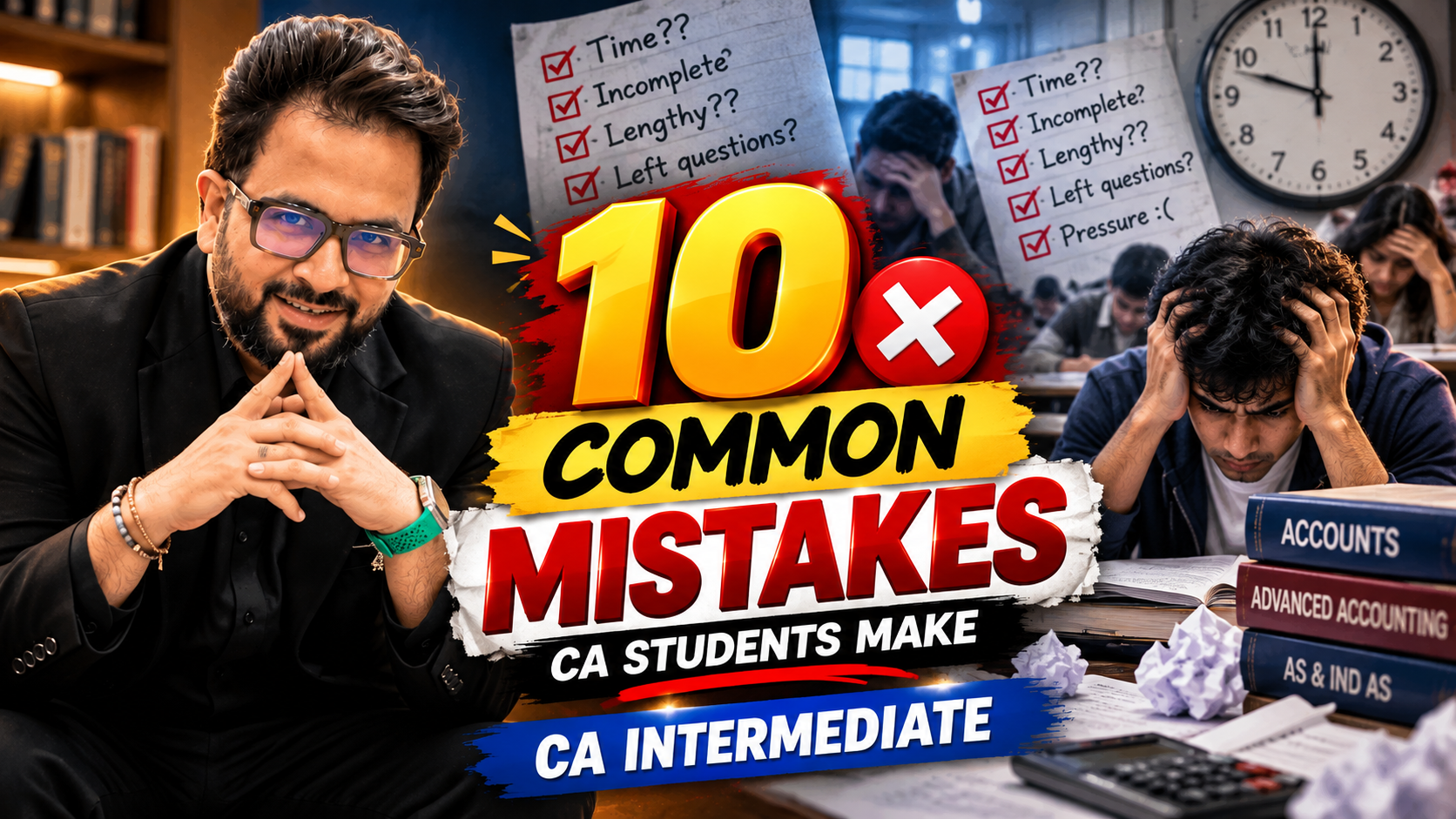

"Sir, paper toh aata tha, lekin time hi nahi mila!"
If you are a CA student, chances are you have either said this after an examination or heard it from a friend.
After almost every Accounting or Advanced Accounting examination, I hear students say that they knew the questions but could not complete the paper. Some leave questions unfinished, while others spend so much time perfecting a single answer that they have very little time left for the remaining paper.
And this makes me wonder: if you knew how to solve the questions, what stopped you from completing the paper?
Very often, the problem is not a lack of knowledge. It is time management during the examination.
Whether you are preparing for CA Foundation or CA Intermediate, learning how to distribute your time can make a real difference to your examination strategy.
Let's understand how.
1. First, Understand How Much Time You Actually Have
Imagine you are sitting for a 100-mark examination with 180 minutes available.
You have three hours to read the questions, understand what is required, calculate, write your answers and check your work.
Here is a simple calculation:
180 minutes ÷ 100 marks = 1.8 minutes per mark.
This gives you a useful starting point for planning your time.
Marks allotted — Average time available:
2 marks = 3.6 minutes
4 marks = 7.2 minutes
5 marks = 9 minutes
8 marks = 14.4 minutes
10 marks = 18 minutes
15 marks = 27 minutes
20 marks = 36 minutes
These are planning benchmarks, not rigid limits for every question. A practical question may require more calculation, while a straightforward question may take less time. Always follow the examination instructions and the actual marks and requirements of the question.
But the principle is simple: your time allocation should broadly match the marks you are attempting.
If you spend 30 minutes on a question worth 10 marks, you need to consider whether those extra 12 minutes are worth it when other questions are still waiting.
2. The Biggest Mistake: Trying to Make Every Answer Perfect
Let me give you a situation that many students will recognise.
You are attempting a 10-mark question. You know the concept, your calculations are almost complete, and your answer looks correct. But you are not completely satisfied with one figure.
You check it once.
Then again.
You rewrite a working note. You recalculate a figure. You try to make the answer absolutely perfect.
Suddenly, 25 minutes have passed.
Now imagine that another 10-mark question remains untouched.
You have spent seven extra minutes on the first question, but you may have lost the opportunity to attempt a substantial part of the second one.
This is where students need to change their approach.
I am not suggesting that you should be careless or leave incorrect calculations unchecked. Accuracy matters. But there is a difference between checking an answer sensibly and spending excessive time trying to perfect it.
Your objective is not to write one perfect answer. Your objective is to make the best possible use of the entire paper.
Complete the essential requirements, verify your calculations reasonably and move ahead. If time remains at the end, return to the answers that need another look.
3. Knowing the Answer and Completing the Answer Are Two Different Skills
Many students practise questions comfortably at home but struggle to finish the paper in the examination hall.
Why?
At home, you can pause a lecture, refer to your notes, check a solution or spend another ten minutes understanding a difficult adjustment.
In the examination, you have a fixed amount of time.
For example, a CA Intermediate student may know how to solve a question involving amalgamation or an Accounting Standard. However, if the student takes too long to organise the workings and write the solution, the same knowledge may not translate into a completed answer within the available time.
Similarly, a CA Foundation student may understand a practical question but spend too much time on one difficult calculation instead of moving to the next question.
The solution is not simply to study harder. It is to practise applying what you know under examination conditions.
Solve questions independently, use a timer and develop a habit of writing clear solutions without repeatedly referring to your notes.
4. Practise Full-Length Mock Tests, Not Just Individual Questions
Solving individual questions is important, but it does not fully prepare you for a three-hour examination.
When you practise one question at a time, you do not have to decide how to distribute your time across the entire paper.
A full-length mock test teaches you to manage the complete examination experience: reading, planning, solving, writing and moving forward when a question takes longer than expected.
Here is what I recommend:
Practise full papers within the prescribed time.
Use question papers and mock tests relevant to your examination attempt.
Record how long you spend on individual questions.
Identify the questions that regularly take longer than expected.
Analyse your mistakes after every test.
Do not measure your mock-test performance only by marks. Also measure how effectively you used the available time.
5. Learn When to Move to the Next Question
Students sometimes continue struggling with a question because they have already invested a lot of time in it.
They think, "I have spent 20 minutes on this. Let me finish it now."
But the time already spent cannot be recovered. The important decision is what you do with the time that remains.
Suppose you are solving a practical question and have completed most of the required workings, but one adjustment is taking much longer than expected.
Instead of spending another ten minutes on that adjustment, mark the point where you stopped and move to a question you can attempt.
You can return to the unfinished part later if time permits.
This does not mean abandoning every difficult question. It means recognising when continuing is no longer the best use of your available time.
Do not let one difficult question decide the fate of your entire paper.
6. Do Not Confuse Writing More with Scoring More
Some students believe that longer answers automatically lead to better marks.
As a result, they write lengthy explanations, repeat information or include unnecessary details even when the question requires a more direct response.
In practical subjects, the focus should be on answering the requirement, applying the relevant concept and presenting calculations clearly.
Before writing, ask yourself:
What exactly has the question asked?
Which calculations or explanations are necessary?
Can I present the answer more clearly without repeating myself?
For theory questions, answer what has been asked. For practical questions, show the necessary workings and present the conclusion clearly.
The aim is not to write the longest answer. It is to write a relevant, accurate and understandable answer within the available time.
7. Keep Checking Your Time During the Examination
One common mistake is checking the clock only when students realise that the examination is almost over.
By that point, they may already have spent too much time on a few questions.
Instead, decide in advance when you will check the time. Compare your progress with your planned allocation and make adjustments when necessary.
If you are falling behind, avoid spending additional time on a question simply because you are comfortable with it.
Your strategy should be based on the marks available, the requirements of the question and the time remaining.
Remember to account for any reading time or other instructions specified by the examination authority.
8. Analyse Why You Could Not Finish Your Mock Test
After a mock test, students often focus only on their marks.
If the score is low, they decide to revise more. If the score is good, they assume everything is fine.
But consider this example.
A student understands questions worth 80 marks but completes only 60 marks because the first few questions took too long.
The student may not need to spend all the next revision session studying the same concepts again. The more immediate priority may be improving time allocation and writing speed.
Another student completes the entire paper but makes several errors in accounting treatment. That student needs to work on accuracy and conceptual understanding.
These are two different problems and require two different solutions.
After each mock test, ask yourself:
1. How many marks did I complete?
2. Which questions took longer than planned?
3. Did I spend too much time perfecting one answer?
4. Did I leave questions unfinished despite knowing the concepts?
5. Were my mistakes caused by a lack of knowledge, slow working or calculation errors?
Your answers will help you prepare more intelligently for the next examination.
9. A Simple Time-Management Strategy for CA Foundation and Intermediate
Before your next mock test, follow this process.
Step 1: Understand the paper. Read the instructions carefully and understand the marks and requirements.
Step 2: Make a time plan. For a 100-mark, 180-minute paper, begin with the 1.8-minute-per-mark benchmark.
Step 3: Attempt questions efficiently. Give each question an appropriate amount of time based on its marks and complexity.
Step 4: Avoid unnecessary perfection. Once you have addressed the essential requirements and checked your work reasonably, move forward.
Step 5: Monitor your progress. Check whether you are broadly following your time plan.
Step 6: Review if time permits. Return to unfinished parts or check important calculations, following the examination instructions.
Practise this process during mock tests rather than waiting until the actual examination day.
Frequently Asked Questions
How can I finish my CA Foundation or CA Intermediate paper on time?
Practise full-length papers under timed conditions, allocate time according to marks, avoid spending excessive time on one answer and analyse your performance after every mock test.
How many minutes should I spend on each mark in a CA exam?
For a 100-mark paper with 180 minutes available, the average is 1.8 minutes per mark. Treat this as a planning benchmark and adjust according to the question requirements and official examination instructions.
What should I do if I get stuck on a question during the exam?
If you have spent more time than planned and are unable to make progress, move to another question you can attempt. Return to the unfinished part later if time permits.
Is practising mock tests important for CA Foundation and Intermediate?
Yes. Mock tests help you practise time allocation, identify slow-solving habits and understand whether you can complete the paper within the prescribed duration.
Should I try to make every answer perfect in a CA exam?
Aim for accuracy and clear presentation, but do not sacrifice the rest of the paper in pursuit of perfection. Complete the essential requirements, check your work sensibly and move forward.
Final Words: The Paper May Be Lengthy, But Your Strategy Matters
The next time you come out of an examination saying, "Sir, paper toh aata tha, lekin lengthy tha," stop for a moment and think about how you used those 180 minutes.
Did you distribute your time according to the marks? Did you spend too long perfecting one answer? Did you practise enough full-length papers before the examination?
You may not be able to control how lengthy a paper feels, but you can improve how you manage your time.
Start with a time budget. Practise moving ahead when necessary. Analyse your mock tests honestly and make small improvements before your next examination.
And if you have a friend who always says, "I knew the paper, but I couldn't complete it," share this article with them. Discuss your time-management strategies, practise together and help each other avoid the same mistakes.
Because sometimes, the difference between knowing the answer and completing the paper is simply knowing when to move on.
All the best for your CA Foundation and CA Intermediate examinations!
— CA Rohit Sethi