
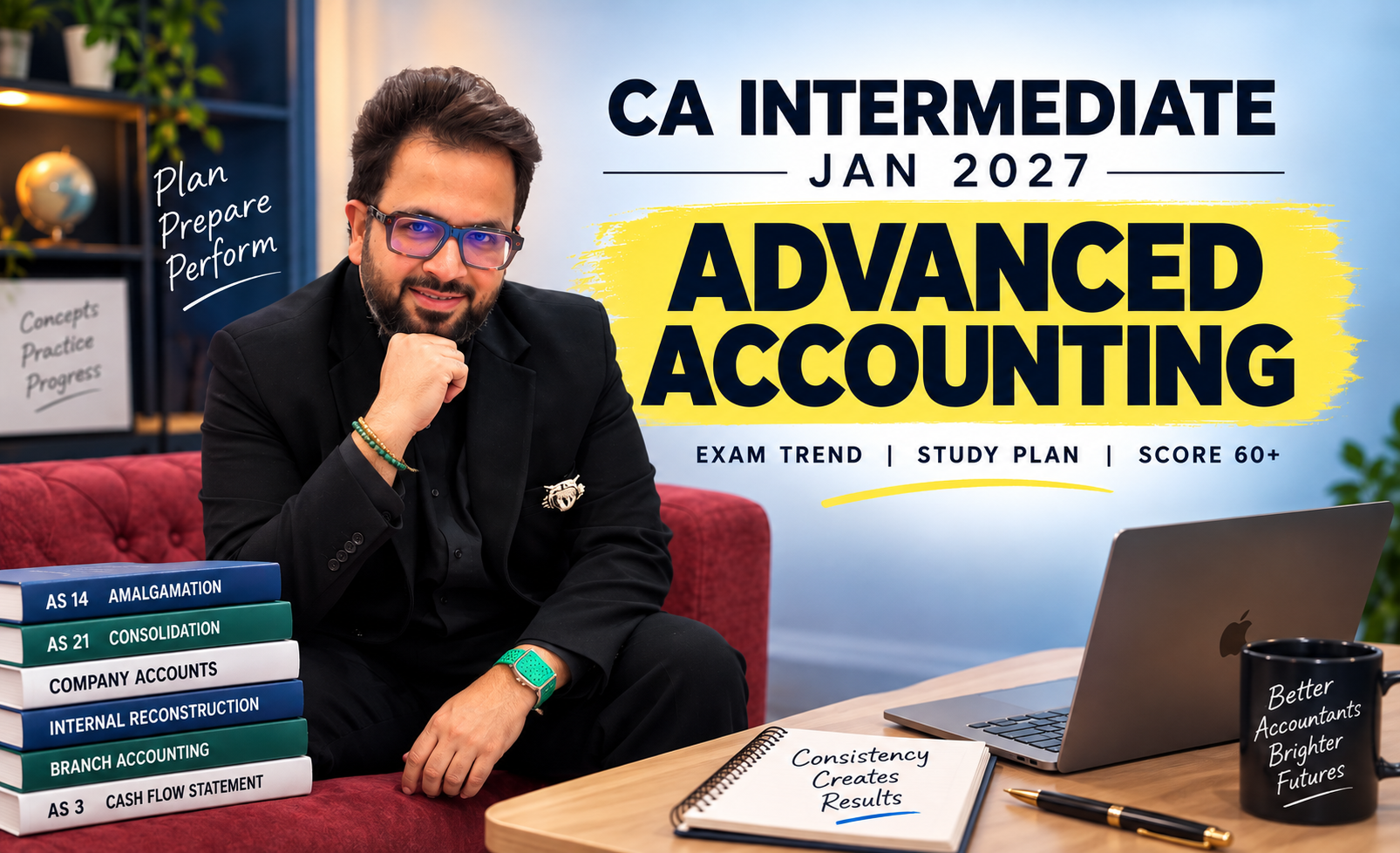
Important Chapters, Previous Exam Trends, Study Sequence & Exemption-Oriented Preparation Strategy
Introduction
Preparing for CA Intermediate January 2027 and wondering which chapters you should focus on first in Advanced Accounting?
Advanced Accounting is a subject where the right combination of conceptual clarity, question practice and revision can make a big difference. At the same time, students often get confused about which chapters deserve more preparation time and which topics they should revise first.
To help with this, we analysed the recent CA Intermediate Advanced Accounting examination trend and looked at the chapter-wise marks covered across the recent attempts. This analysis can help you understand which chapters have appeared more consistently and how you can prioritise your preparation for the January 2027 examination.
However, ICAI does not officially announce chapter-wise weightage or guarantee that a particular chapter will carry a particular number of marks. Therefore, the analysis below should be used as a preparation and revision guide, not as a prediction of the actual question paper.
How We Analysed the Previous 6 Attempts
We reviewed the chapter-wise marks coverage of the six recent CA Intermediate Advanced Accounting examination attempts — January 2025, May 2025, September 2025, January 2026, May 2026 and September 2026.
The analysis considers frequency of appearance, marks covered and consistency across attempts. The resulting priority list is intended to help students plan their preparation and revision. It should not be treated as official ICAI weightage or a guaranteed prediction for January 2027.
CA Intermediate Advanced Accounting Previous Exam Trend: What Do the Last 6 Attempts Tell Us?
Before discussing the important topics for January 2027, let us first look at the pattern followed in the recent CA Intermediate Advanced Accounting examinations.
Some chapters appear repeatedly with relatively consistent marks, while others appear intermittently and may carry different marks from one attempt to another. This distinction is important when planning preparation.
| Chapter | Jan 25 | May 25 | Sep 25 | Jan 26 | May 26 | Sep 26 |
|---|---|---|---|---|---|---|
| AS 14 – Amalgamation | 14 | 14 | 14 | 14 | 14 | 18 |
| AS 21 – Consolidation | 14 | 14 | 14 | 14 | 10 | 14 |
| Company Final Accounts | 4 | 18 | 14 | 4 | 14 | 10 |
| Internal Reconstruction | 14 | – | 4 | 14 | 8 | 4 |
| Branch Accounting | 6 | 6 | 6 | 6 | 6 | 6 |
| AS 3 – Cash Flow | 7 | 7 | 7 | – | 6 | 10 |
| AS 15 | 4 | – | – | 4 | 5 | – |
| AS 20 | 5 | – | – | 5 | – | 4 |
| AS 19 | 5 | – | – | – | – | 5 |
| AS 13 | – | 7 | – | 7 | – | – |
| AS 28 | – | – | 4 | – | – | 7 |
| Buy-back | 4 | – | – | 7 | – | – |
Source: Chapter-wise analysis of the six recent examination attempts.
What Does This Trend Tell Us?
The first thing we notice is that not every chapter follows the same pattern. Some chapters have a high frequency of appearance, while others are more rotational. Some chapters also show significant variation in marks.
Which Chapters Have Appeared in Every Recent Attempt?
AS 14 – Amalgamation
6 out of 6 attempts. Marks covered: 14 → 14 → 14 → 14 → 14 → 18. This is a very consistent pattern with substantial coverage in every attempt analysed.
AS 21 – Consolidated Financial Statements
6 out of 6 attempts. Marks covered: 14 → 14 → 14 → 14 → 10 → 14. The chapter has appeared in every attempt considered.
Company Final Accounts
6 out of 6 attempts. Marks covered: 4 → 18 → 14 → 4 → 14 → 10. Frequency is consistent, although the marks vary considerably.
Branch Accounting
6 out of 6 attempts. Marks covered: 6 → 6 → 6 → 6 → 6 → 6. This is one of the clearest patterns in the analysis.
What About Internal Reconstruction?
Internal Reconstruction has appeared in 5 out of the last 6 attempts. The marks were: 14 → Not tested → 4 → 14 → 8 → 4.
The chapter appears frequently, but the marks are not fixed. Therefore, it would be incorrect to assume that it will always carry 14 marks. A more appropriate conclusion is that Internal Reconstruction has been a frequently tested area and should receive strong preparation, although its marks can vary considerably.
What Does the AS 3 Trend Show?
AS 3 – Cash Flow Statement appeared in 5 of the 6 attempts analysed. The marks covered were: 7 → 7 → 7 → Not tested → 6 → 10.
The recent papers also show continued testing of the chapter. This makes AS 3 another area that deserves significant attention during preparation and revision.
Which Chapters Are Most Important for CA Intermediate Advanced Accounting January 2027?
Based on the recent examination trend analysed, some chapters have appeared much more consistently than others. The following chapters should be given higher priority during preparation and revision:
- AS 14 – Amalgamation
- AS 21 – Consolidated Financial Statements
- Company Final Accounts
- Internal Reconstruction
- Branch Accounting
- AS 3 – Cash Flow Statement
Is AS 14 Amalgamation Important for CA Intermediate January 2027?
AS 14 – Amalgamation is one of the strongest recurring areas in the recent examination trend. In the six recent attempts analysed, AS 14 appeared consistently and carried substantial coverage.
Students should focus on:
- Purchase consideration
- Methods of calculating purchase consideration
- Accounting entries in the books of the transferor company
- Accounting entries in the books of the transferee company
- Treatment of reserves
- Treatment of goodwill
- Treatment of capital reserve
- Practical problems involving amalgamation
- Adjustments relating to assets and liabilities
Trend-based marks covered in the recent attempts have generally been in the range of 14–18 marks. Students should prepare this chapter thoroughly and solve a good variety of practical questions.
Is AS 21 Consolidation Important for CA Intermediate?
AS 21 – Consolidated Financial Statements is another chapter that has appeared consistently in the recent papers analysed.
Important areas include:
- Holding and subsidiary relationship
- Calculation of goodwill or capital reserve
- Minority interest
- Pre-acquisition profits
- Post-acquisition profits
- Inter-company transactions
- Unrealised profit
- Revaluation of assets and liabilities
- Treatment of dividends
- Preparation of Consolidated Balance Sheet
The recent trend shows coverage broadly around 10–14 marks. AS 21 should be prepared thoroughly, with sufficient practical question practice.
How Important Are Company Final Accounts for CA Intermediate?
Company Final Accounts is another chapter that has appeared regularly in the recent examination trend. The marks have varied across different attempts, so students should not assume that it will always carry a fixed number of marks.
Students should practise:
- Statement of Profit and Loss
- Balance Sheet
- Notes to Accounts
- Various adjustments
- Schedule-related requirements
- Important company accounting adjustments
- Complete practical questions
The trend-based coverage has broadly ranged from around 4 to 18 marks across the attempts analysed, with several papers having significant coverage. Students should not leave Company Final Accounts for the last stage of preparation.
How Important Is Internal Reconstruction for CA Intermediate?
Internal Reconstruction has also appeared frequently in the recent examination trend. Unlike some other chapters, its marks have varied considerably from one attempt to another.
Important areas include:
- Reduction of share capital
- Reorganisation of share capital
- Reduction of liabilities
- Treatment of accumulated losses
- Reconstruction Account
- Journal entries
- Treatment of assets and liabilities
- Preparation of revised Balance Sheet
The trend-based range has been approximately 4–14 marks across the attempts analysed. A good understanding of the basic accounting treatment along with extensive practical practice is important for this chapter.
Is Branch Accounting a Scoring Chapter in CA Intermediate Advanced Accounting?
Branch Accounting shows one of the clearest patterns in the recent examination trend. In the six attempts analysed, the chapter appeared consistently with approximately 6 marks of coverage.
Important areas include:
- Dependent branches
- Debtors System
- Stock and Debtors System
- Goods sent to branch
- Loading
- Branch expenses
- Branch Adjustment Account
- Branch Account
- Practical adjustments
Because of its consistent appearance, Branch Accounting deserves a place in the first stage of preparation. Trend-based coverage: around 6 marks.
Is AS 3 Cash Flow Statement Important for CA Intermediate?
AS 3 – Cash Flow Statement has also appeared regularly in the recent papers analysed.
Students should be comfortable with the classification and treatment of different transactions under Operating Activities, Investing Activities and Financing Activities.
Important areas include:
- Indirect method
- Adjustments for non-cash items
- Working capital adjustments
- Interest
- Dividend
- Tax
- Purchase and sale of fixed assets
- Issue and redemption of shares and debentures
- Preparation of Cash Flow Statement
The recent trend shows coverage broadly around 6–10 marks. AS 3 is a chapter where regular practice can improve speed and accuracy.
What Are the Other Important Chapters for CA Intermediate Advanced Accounting?
The chapters mentioned above should receive additional attention based on the recent trend, but students should not stop there.
- AS 1 – Disclosure of Accounting Policies
- AS 2 – Valuation of Inventories
- AS 4 – Contingencies and Events Occurring After the Balance Sheet Date
- AS 5 – Net Profit or Loss, Prior Period Items and Changes in Accounting Policies
- AS 7 – Construction Contracts
- AS 9 – Revenue Recognition
- AS 10 – Property, Plant and Equipment
- AS 11 – Effects of Changes in Foreign Exchange Rates
- AS 12 – Accounting for Government Grants
- AS 13 – Accounting for Investments
- AS 15 – Employee Benefits
- AS 16 – Borrowing Costs
- AS 17 – Segment Reporting
- AS 18 – Related Party Disclosures
- AS 19 – Leases
- AS 20 – Earnings Per Share
- AS 22 – Accounting for Taxes on Income
- AS 23 – Accounting for Investments in Associates
- AS 24 – Discontinuing Operations
- AS 25 – Interim Financial Reporting
- AS 26 – Intangible Assets
- AS 27 – Financial Reporting of Interests in Joint Ventures
- AS 28 – Impairment of Assets
- AS 29 – Provisions, Contingent Liabilities and Contingent Assets
- Buy-back of Securities
What Is the Best Order to Study Advanced Accounting for CA Intermediate January 2027?
If you are starting your preparation or planning your revision, you can follow this sequence:
AS 14 → AS 21 → Company Final Accounts → Internal Reconstruction → Branch Accounting → AS 3 → Other Important Accounting Standards → Remaining Syllabus
The purpose of this sequence is not to tell you what will come in the examination. It is to help you decide what you should prepare and revise first based on the recent trend.
Why Are We Recommending This Sequence?
The recommendation is based on three factors:
- Frequency of appearance – How often has the chapter appeared in recent attempts?
- Marks coverage – When the chapter appeared, how much of the paper was covered by it?
- Recent trend – Has the chapter continued to appear in the latest examinations?
This gives students a more logical way to prioritise their preparation instead of relying on assumptions or random predictions.
Can You Score 60+ in CA Intermediate Advanced Accounting by Following This Strategy?
A high score requires more than simply completing important chapters. If you follow the sequence above, understand every concept properly and practise an ample number of questions, you can build a strong preparation base for aiming for 60+ marks.
Your preparation should include:
- Concept clarity
- ICAI Study Material questions
- Past examination questions
- RTPs
- MTPs
- Ample practice
- Revision
- Mock tests
The number of questions you solve matters, but the quality of your practice matters just as much. When solving a question, do not immediately look at the solution if you get stuck. First identify where you went wrong, understand the adjustment and then solve the question again.
How Many Questions Should You Practise for CA Intermediate Advanced Accounting?
There is no single number of questions that guarantees a particular score. Instead of counting only the questions you have read, count the questions that you have actually solved yourself.
Your practice should ideally cover:
- ICAI Study Material
- Previous examination questions
- RTPs
- MTPs
- Important revision questions
- Different types of practical adjustments
- Full-length mock papers
You should also revisit questions that you got wrong the first time. A student who solves questions carefully and learns from mistakes gains much more from practice than a student who simply reads a large number of solutions.
Is It Enough to Study Only the Important Chapters for CA Intermediate Advanced Accounting?
No. Trend analysis is useful for prioritising preparation, but it should not become a reason to skip chapters completely.
ICAI can change the pattern, difficulty level and distribution of questions from one examination to another.
Therefore, use the trend to answer: “Which chapters should I prepare first and revise more?” Do not use it to answer: “Which chapters can I completely leave?”
If your target is an exemption, complete syllabus preparation combined with extensive question practice is a much stronger approach.
How Should You Prepare for an Exemption in Advanced Accounting?
Step 1: Complete the Concepts
Understand the accounting treatment before starting extensive question practice.
Step 2: Solve ICAI Study Material Questions
Make sure you can solve the relevant questions without looking at the answer.
Step 3: Practise Previous Examination Questions
This helps you understand how concepts can be tested in different forms.
Step 4: Solve RTPs and MTPs
Use them as part of your revision and examination practice.
Step 5: Maintain a Mistake Book
Write down adjustments, concepts and mistakes that you repeatedly get wrong.
Step 6: Revise Difficult Questions
Do not revise only theory. Re-solve questions that you found difficult.
Step 7: Attempt Full-Length Papers
Practise writing the complete paper within the prescribed time.
Step 8: Analyse Your Performance
Identify questions you could not solve, calculation mistakes, conceptual mistakes, presentation issues and time-management problems.
What Mistakes Should You Avoid While Preparing Advanced Accounting?
Studying Only Predicted Chapters
Past trends can change. Never depend entirely on predictions.
Reading Solutions Without Solving Questions
A solution may look easy when reading it, but the examination requires independent solving.
Ignoring Accounting Standards
Accounting Standards form an important part of Advanced Accounting and should receive regular revision.
Leaving Practical Chapters for the End
Chapters such as AS 14, AS 21, Company Final Accounts and Internal Reconstruction require practice.
Not Revising Mistakes
If you make the same mistake repeatedly, analyse it before simply solving more questions.
Not Practising With a Time Limit
You should be able to solve and present answers within the examination time.
Can You Get an Exemption by Studying High-Weightage Chapters?
High-priority chapters can help you use your preparation time more effectively, but studying selected chapters alone cannot guarantee an exemption.
If your goal is to aim for an exemption, use the trend analysis as a starting point:
Prioritise → Prepare Thoroughly → Practise Extensively → Revise → Test Yourself
If you follow the suggested sequence and practise an ample number of questions, you can build a strong foundation for exemption-oriented preparation.
CA Intermediate January 2027 Advanced Accounting FAQs
How can I score 60+ in CA Intermediate Advanced Accounting?
Focus on conceptual clarity, complete the ICAI Study Material, solve past examination questions, practise RTPs and MTPs, revise regularly and attempt full-length mock papers.
How can I aim for an exemption in CA Intermediate Advanced Accounting?
Complete the syllabus properly, prioritise the frequently tested areas, practise an ample number of questions and work on speed, accuracy and presentation.
Which chapters are important for CA Intermediate Advanced Accounting January 2027?
Based on the recent examination trend analysed, AS 14, AS 21, Company Final Accounts, Internal Reconstruction, Branch Accounting and AS 3 deserve particular attention.
Which chapter should I study first in Advanced Accounting?
Based on the recent trend, you can begin with AS 14 – Amalgamation, followed by AS 21, Company Final Accounts, Internal Reconstruction, Branch Accounting and AS 3.
Is AS 14 important for CA Intermediate?
Yes. AS 14 has appeared consistently in the recent attempts analysed and has carried significant marks in those papers.
Is AS 21 important for CA Intermediate?
Yes. AS 21 has also shown a strong recurring pattern in the recent examination trend.
Is Branch Accounting important for CA Intermediate?
Yes. Branch Accounting has shown a particularly consistent pattern in the recent papers analysed.
Can I prepare Advanced Accounting only by studying important chapters?
It is not advisable to rely only on selected chapters. Use important-chapter analysis to prioritise your preparation, but complete the syllabus and revise all relevant areas.
How many questions should I practise for Advanced Accounting?
There is no fixed number that guarantees a particular score. Practise enough questions to cover ICAI Study Material, previous examinations, RTPs, MTPs and different types of adjustments.
How should I prepare Advanced Accounting for January 2027?
Start with the high-priority chapters, build strong conceptual clarity, practise extensively, complete the remaining syllabus, revise regularly and test yourself through full-length papers.
Final Strategy for CA Intermediate January 2027
Advanced Accounting should not be prepared by simply trying to guess the question paper.
The smarter approach is to understand the recent trend, prioritise important areas and then combine that with complete syllabus preparation and extensive question practice.
For January 2027, the chapters that stand out in the recent trend analysis are:
- AS 14 – Amalgamation
- AS 21 – Consolidated Financial Statements
- Company Final Accounts
- Internal Reconstruction
- Branch Accounting
- AS 3 – Cash Flow Statement
These chapters deserve additional attention, but the remaining Accounting Standards and chapters should not be ignored.
If you follow the suggested sequence, understand the concepts thoroughly and practise an ample number of questions, you can build a strong preparation base to aim for 60+ marks and an exemption.
The key is simple:
Don’t just study the chapter. Solve it.
Don’t just solve it once. Revise it.
Don’t just revise it. Test yourself.
And most importantly, don’t depend only on predictions — prepare to handle the paper.
All the best for CA Intermediate January 2027!
Disclaimer: This article is based on an analysis of recent CA Intermediate Advanced Accounting examination papers and is intended only as a study-planning guide. The marks/ranges mentioned are trend-based and are not official ICAI weightage, predictions or guarantees. Students are advised to follow the applicable ICAI syllabus and study material for their examination attempt.